


Why After-Hours Commercial Cleaning Matters for Hobart Businesses
Your business is still operating.
Employees are working, customers are coming through the door, patients are arriving for appointments and staff are trying to keep up with the day.
So when should the cleaning happen?
For many businesses, cleaning during busy operating hours can create unnecessary disruption. Vacuums, mops, cleaning equipment, wet floors and cleaners moving between work areas can make it harder for employees to work and customers to move around the property.
This is where after-hours cleaning Hobart can make practical sense.
Cleaning can be scheduled before a business opens, after it closes, during quieter periods or on weekends, depending on the property and its operating requirements.
The goal isn’t simply to clean outside normal hours.
It’s to find a cleaning schedule that allows the business to operate while the cleaning team can work efficiently.
What Is After-Hours Commercial Cleaning?
After-hours commercial cleaning means cleaning a business premises outside its busiest operating period.
Depending on the business, this could mean:
- Early morning cleaning before staff arrive
- Evening cleaning after the business closes
- Weekend cleaning
- Cleaning during scheduled shutdown periods
- Cleaning during quieter operating periods
The exact arrangement depends on the business, its opening hours, building access and cleaning requirements.
For example, an office may be cleaned after employees leave for the day, while a retail business may require cleaning after closing.
A medical practice may prefer cleaning after the final appointments, while a hospitality business may need cleaning around its service periods.
There is no single after-hours schedule that works for every business.
Why Do Businesses Choose After-Hours Cleaning?
The main reason is simple:
The business can operate without the cleaning process getting in the way.
During a busy day, cleaning can sometimes compete with normal workplace activity.
Employees may need access to desks.
Customers may need to walk through reception areas.
Patients may need to access consultation rooms.
Retail customers may be browsing aisles.
Restaurant staff may be preparing food or serving customers.
After-hours cleaning creates a separate window in which the cleaning team can work without competing with those activities.
Local Hobart commercial cleaning providers already promote cleaning outside trading or office hours and scheduling around access, alarms and site requirements.
1. Cleaning Before Employees Arrive
Early-morning cleaning can work well for businesses that want the workplace ready before the working day begins.
The cleaning team can complete tasks such as:
- Vacuuming
- Mopping
- Bathroom cleaning
- Kitchen cleaning
- Bin removal
- Surface cleaning
- Glass and door cleaning
- High-touch surface cleaning
Employees then arrive to a workplace that has already been cleaned.
This can be particularly useful when the office has predictable morning start times and limited overnight access restrictions.
2. Cleaning After the Business Closes
Evening cleaning is another common option.
Once employees and customers have left, cleaners can work through the premises without navigating normal daytime activity.
Depending on the cleaning scope, this may include:
- Workstations
- Reception
- Meeting rooms
- Floors
- Bathrooms
- Kitchens
- Common areas
- Glass
- Waste areas
This can be particularly useful for businesses that want the main cleaning activities completed after the final staff or customers have left.
3. Weekend Commercial Cleaning
Some businesses operate throughout the week but have quieter periods on weekends.
For these workplaces, weekend cleaning can provide an additional opportunity for detailed cleaning without interrupting weekday operations.
Weekend cleaning may be suitable for:
- Offices
- Retail premises
- Commercial buildings
- Showrooms
- Some medical facilities
- Other workplaces with reduced weekend activity
It can also be useful for periodic cleaning tasks that take longer than a normal routine visit.
Does After-Hours Cleaning Reduce Employee Disruption?
It can.
When cleaning takes place during busy working hours, cleaners may need to work around:
- Employees
- Meetings
- Phone calls
- Customers
- Visitors
- Deliveries
- Equipment
- Shared workspaces
This can slow down the cleaning process or require certain tasks to be postponed.
After-hours cleaning creates a dedicated period where cleaners can access areas that may be difficult to clean while the business is operating.
For example, vacuuming a busy office during the middle of the working day may be inconvenient.
Doing the same task after employees have left can be considerably easier.
What About Customer Disruption?
Customer-facing businesses have another consideration.
A customer walking into a shop, showroom or professional practice doesn’t necessarily want to navigate:
- Wet floors
- Cleaning equipment
- Vacuum cables
- Cleaning carts
- Open waste bins
- Staff cleaning around them
A clean business should still be easy to access while it is operating.
For retail, hospitality and customer-facing businesses, scheduling cleaning around trading hours can therefore help separate customer service from cleaning activity.
4. After-Hours Cleaning for Offices
Offices are one of the clearest examples of where after-hours cleaning can be useful.
During the working day, employees may be:
- Working at desks
- Attending meetings
- Using kitchens
- Moving between rooms
- Making phone calls
- Hosting visitors
Cleaning after employees leave can allow cleaners to work through:
- Workstations
- Floors
- Meeting rooms
- Kitchens
- Bathrooms
- Reception areas
- Common areas
Westlife Australia’s office-cleaning service specifically offers after-hours or early-morning availability, alongside structured cleaning programs and supervisor quality checks.
5. After-Hours Cleaning for Medical Practices
Medical facilities have additional scheduling considerations.
Patients may be arriving throughout the day, while healthcare staff need access to consultation and treatment areas.
Depending on the practice, cleaning may therefore be scheduled:
- Before opening
- After the final appointments
- During quieter periods
- At other agreed times
Areas may include:
- Reception
- Waiting areas
- Consultation rooms
- Bathrooms
- Staff areas
- Floors
- High-touch surfaces
The appropriate schedule should be based on the facility, its operating hours and its cleaning requirements.
For healthcare facilities, the cleaning plan should also follow the facility’s relevant procedures and requirements rather than simply applying a standard office schedule.
6. After-Hours Cleaning for Retail Businesses
Retail businesses have a different challenge.
Customers need access to:
- Entrances
- Aisles
- Counters
- Displays
- Fitting rooms
- Bathrooms
Cleaning these areas while customers are actively shopping can create unnecessary interruptions.
An after-hours schedule can allow cleaners to work through the premises once customer traffic has reduced or stopped.
This can include:
- Floor cleaning
- Glass cleaning
- Dusting
- Bathroom cleaning
- High-touch surfaces
- Waste removal
- Detailed cleaning around displays
For businesses with late trading hours, early-morning cleaning may be more practical than evening cleaning.
7. After-Hours Cleaning for Hospitality Businesses
Restaurants, cafés, pubs and other hospitality venues often have very different operating schedules from offices.
Cleaning may need to work around:
- Food preparation
- Lunch service
- Dinner service
- Customer seating
- Kitchen operations
- Deliveries
- Staff shifts
Trying to complete major cleaning tasks during busy service periods isn’t always practical.
Depending on the venue, cleaning may be scheduled before opening, after service or during quieter periods.
Tasks can include:
- Floors
- Dining areas
- Bathrooms
- Kitchen areas
- Glass
- Surfaces
- Waste areas
- High-touch points
The exact scope should be determined according to the venue and its operating requirements.
Does After-Hours Cleaning Improve Cleaning Efficiency?
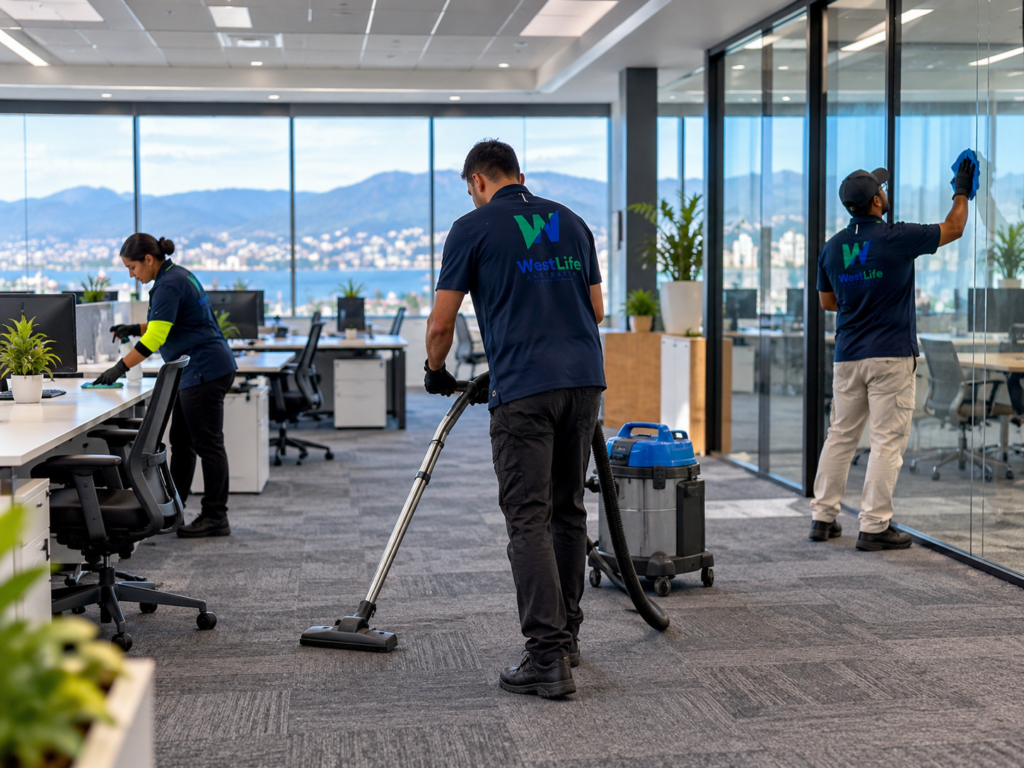
It can make certain tasks easier to complete because cleaners aren’t constantly working around employees, customers or visitors.
Consider an office with:
100% occupancy during the day
and
almost no employees after 6 PM.
The cleaning team has significantly more freedom to move through:
- Desks
- Meeting rooms
- Corridors
- Kitchens
- Bathrooms
- Open floor areas
This doesn’t automatically mean the cleaning will be better.
The quality still depends on the cleaning scope, equipment, staff, supervision and time allocated.
But having a suitable cleaning window can make the agreed cleaning tasks easier to complete without disrupting normal business activity.
What About Security and Building Access?
After-hours cleaning requires more planning than simply arriving after closing.
Businesses may need to consider:
- Building access
- Keys
- Access cards
- Alarm systems
- Security procedures
- Restricted areas
- Staff-only spaces
- Closing procedures
- Emergency contacts
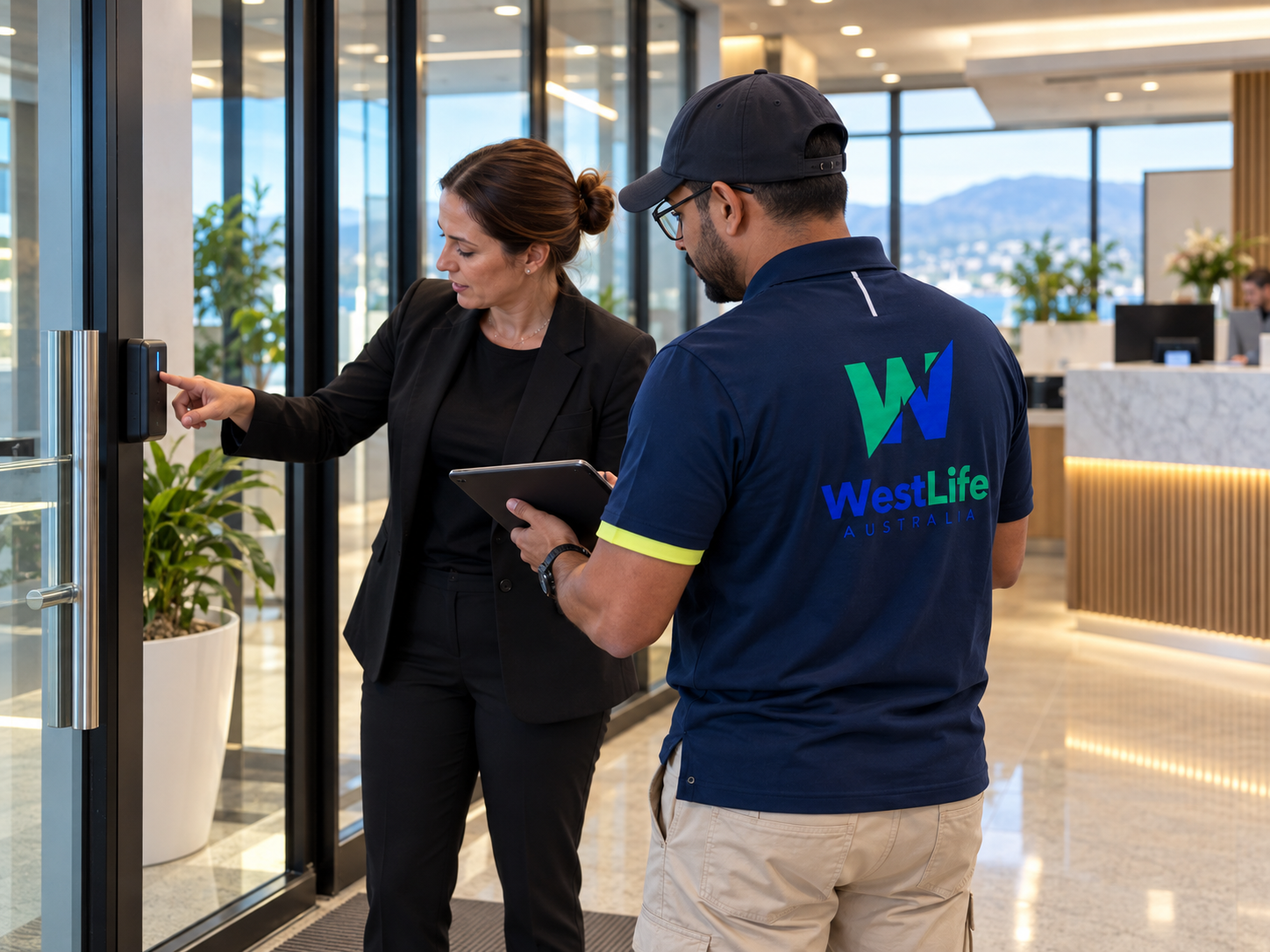
The cleaning company and business should agree on how cleaners will enter and leave the premises.
Local Hobart cleaning providers specifically identify access arrangements and alarms as considerations when organising after-hours cleaning.
A clear access procedure can help avoid confusion when the building is closed.
Should Cleaners Have Access to the Building Alone?
This depends on the business and its security arrangements.
Some organisations may provide:
- Keys
- Access cards
- Alarm codes
- Security instructions
Others may require:
- Security staff
- Building management access
- A designated contact
- Restricted access to certain rooms
Before starting an after-hours cleaning program, these arrangements should be clearly discussed.
The cleaning team should know:
Where they can go → What they can access → What they need to clean → How they leave the site secure
When Does After-Hours Cleaning Actually Make Sense?
After-hours cleaning can be particularly useful when:
Your workplace is busy throughout the day
If employees are constantly moving around the property, cleaning during operating hours may be disruptive.
Customers are continuously visiting
Retail stores, showrooms and professional practices may benefit from cleaning outside peak customer periods.
You need quiet working conditions
Offices and professional workplaces may prefer cleaning when employees aren’t working.
Your premises have large shared areas
Large kitchens, reception areas, corridors and open workspaces may be easier to clean when fewer people are present.
You need periodic detailed cleaning
Some cleaning tasks require more time and access than a quick daytime visit allows.
Your operating hours are predictable
A consistent closing time makes it easier to create a repeatable cleaning schedule.
When Might Daytime Cleaning Be Better?
After-hours cleaning isn’t automatically the best option.
For some businesses, daytime cleaning may actually be more practical.
For example:
- A workplace with very limited staff
- A business with flexible working arrangements
- A facility that operates around the clock
- A building with restricted overnight access
- A business with no suitable after-hours access
- A workplace with naturally quiet periods during the day
In these cases, cleaning during a quieter operating period may work better.
The objective should be to find the least disruptive practical cleaning window, rather than choosing after-hours cleaning simply because it sounds more professional.
After-Hours Cleaning vs Daytime Cleaning
| After-Hours Cleaning | Daytime Cleaning |
| Cleaning takes place outside peak operating periods | Cleaning takes place while the business operates |
| Less employee interaction during cleaning | Cleaners work around employees |
| Less customer disruption | Customers may see cleaning activity |
| Larger areas may be easier to access | Some areas may need to wait until quieter periods |
| Requires planned building access | Access is usually easier |
| Useful for offices and customer-facing businesses | Useful when the workplace has quieter periods |
Neither option is automatically better.
The right choice depends on the business.
How to Create an After-Hours Cleaning Schedule
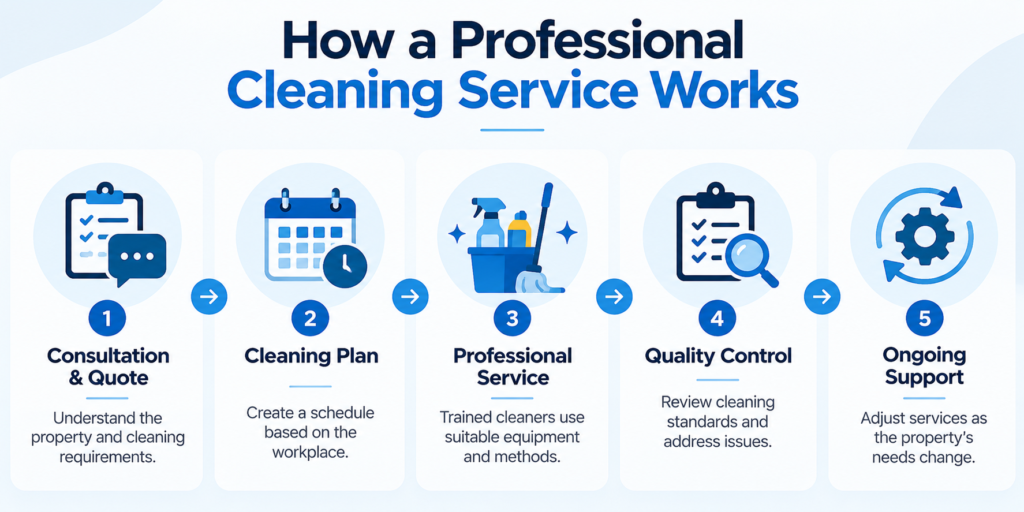
A practical schedule should start with the way your business operates.
Step 1: Identify Operating Hours
Determine when employees, customers or patients are normally present.
Step 2: Identify Quiet Periods
Look for periods when activity is lowest.
Step 3: List the Cleaning Requirements
Separate routine cleaning from periodic or detailed tasks.
Step 4: Review Access
Determine how cleaners will enter, move through and secure the prop lerty.
Step 5: Set the Cleaning Window
Choose a realistic period that provides enough time to complete the agreed tasks.
Step 6: Review the Schedule
If certain areas are repeatedly missed or cleaning takes longer than expected, the schedule may need adjustment.
This approach creates a cleaning program based on the actual operation of the business, rather than simply choosing a standard cleaning time.
What Should Be Included in an After-Hours Commercial Cleaning Plan?
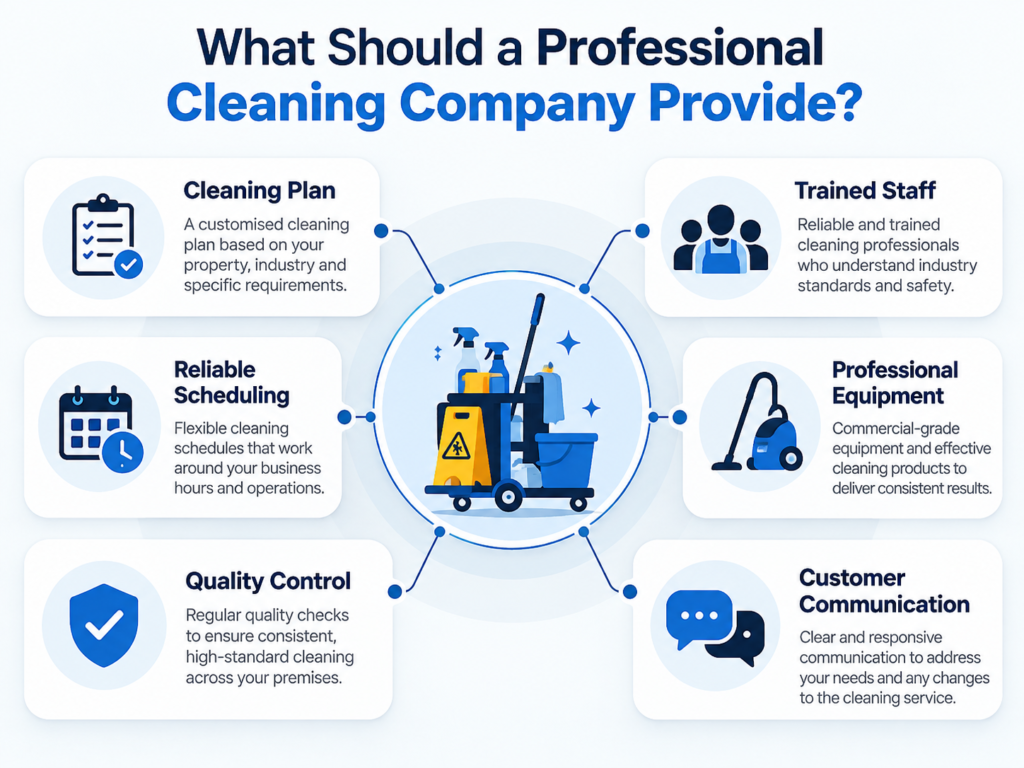
The cleaning schedule should clearly define what is expected.
Depending on the property, this may include:
Office Areas
- Workstations
- Meeting rooms
- Reception
- Common areas
- Floors
- Glass
- Doors
Shared Facilities
- Kitchens
- Break rooms
- Bathrooms
- Waste areas
High-Touch Areas
- Door handles
- Light switches
- Shared equipment
- Reception surfaces
Periodic Cleaning
Depending on the property:
- Carpet cleaning
- Detailed glass cleaning
- Deep cleaning
- Floor maintenance
- Hard-to-reach areas
Clearly defining the scope helps the business and cleaning team understand what needs to be completed during each visit.
What If Your Business Closes Late?
Not every business closes at 5 PM.
Restaurants, gyms, retail stores and other commercial properties may operate well into the evening.
In these situations, the cleaning window could be:
Late evening → Overnight → Early morning
The key is to find a realistic period between operating activity and the next working day.
For example:
Business closes at 10 PM
↓
Cleaning begins at 10:30 PM
↓
Cleaning completed before opening
This can give cleaners enough time to complete the agreed tasks while avoiding disruption to customers and employees.
The exact timing should always be based on the property’s requirements.
What If the Business Operates 24/7?
A 24-hour workplace obviously doesn’t have a traditional “after closing” period.
In that situation, the solution may be to identify lower-traffic periods instead.
For example:
- Early morning
- Overnight quieter periods
- Scheduled shutdowns
- Low-occupancy periods
- Specific areas during temporarily reduced activity
This is another example of why commercial cleaning schedules should be designed around the business rather than using the same schedule for every property.
Why a Tailored Cleaning Schedule Matters
A cleaning schedule should reflect:
Your opening hours
Your employees
Your customers
Your facility
Your cleaning requirements
Your access arrangements
A small professional office may need only a short after-hours cleaning window.
A large commercial property may require several cleaners working across different areas.
A medical practice may have specific rooms that need to be cleaned at particular times.
A restaurant may need cleaning after service.
A retail store may need cleaning before customers arrive.
The cleaning schedule should therefore be built around the actual operation of the site.
Is After-Hours Cleaning Right for Your Hobart Business?
Ask yourself:
☐ Does cleaning during business hours interrupt employees?
☐ Do customers or visitors regularly move through the areas being cleaned?
☐ Are there large areas that are difficult to clean while occupied?
☐ Does your business have predictable opening and closing times?
☐ Would early-morning or evening cleaning be easier?
☐ Do you have suitable building access arrangements?
☐ Are there periodic cleaning tasks that require more uninterrupted time?
If you answered yes to several of these questions, an after-hours cleaning schedule may be worth considering.
However, the best option depends on your premises and operating requirements.
After-Hours Commercial Cleaning Across Hobart and Tasmania
Westlife Australia provides professional commercial cleaning solutions designed around the requirements of each business.
For businesses in Hobart, Kingston, Launceston, Devonport and Burnie, cleaning schedules can be planned around operating hours, workplace activity and the specific cleaning requirements of the property.
This may mean:
Before opening
After closing
During quieter periods
On weekends
The objective is to provide a cleaning schedule that works with the business rather than against it.
Your Business Shouldn’t Have to Work Around the Cleaning
Cleaning is an important part of maintaining a professional commercial property.
But the cleaning process shouldn’t unnecessarily interfere with employees, customers or normal business operations.
For some Hobart businesses, after-hours cleaning provides a practical way to separate cleaning activity from the working day.
For others, early-morning, weekend or quieter-period cleaning may be a better solution.
The right answer depends on the property, operating hours, access arrangements and cleaning requirements.
Does Your Business Need a Cleaning Schedule That Works Around Your Hours?
Westlife Australia provides professional commercial cleaning services tailored to the operating requirements of businesses across Hobart, Kingston, Launceston, Devonport and Burnie.
Whether you need after-hours cleaning, early-morning cleaning, weekend cleaning or a regular commercial cleaning schedule, our team can help develop a practical cleaning plan around your workplace.
Contact Westlife Australia today to discuss your cleaning requirements and request a tailored quote.
FAQs — Why After-Hours Commercial Cleaning Matters for Hobart Businesses
1. What is after-hours cleaning in Hobart?
After-hours cleaning in Hobart means cleaning a business outside its busiest operating periods. This can include early mornings, evenings, weekends or scheduled low-traffic periods, depending on the business.
2. Is after-hours cleaning in Hobart suitable for offices?
Yes. After-hours cleaning in Hobart can be useful for offices because cleaners can work through workstations, meeting rooms, kitchens, bathrooms and common areas after employees have left, reducing disruption during the working day.
3. Can after-hours cleaning in Hobart help reduce disruption to customers?
It can. Scheduling cleaning outside busy customer periods can reduce interruptions caused by vacuuming, wet floors, cleaning equipment and cleaners working around customers or visitors.
4. How do businesses arrange access for after-hours cleaning in Hobart?
Businesses and cleaning providers should agree on access arrangements before cleaning begins. This may include keys, access cards, building security procedures, restricted areas, alarm arrangements and instructions for securing the property after cleaning.
5. Is after-hours cleaning in Hobart suitable for every business?
Not necessarily. After-hours cleaning in Hobart may suit busy offices, retail businesses, medical practices and hospitality venues, while businesses with 24-hour operations or quieter daytime periods may benefit from cleaning during lower-traffic times instead.